The home office has quietly become one of the most important rooms in the house. Whether you work from home full-time or just need a corner for paying bills and answering emails, the space shapes how you think. And one of the most overlooked tools for shaping that space is the art on the walls.
It’s easy to treat office decoration as an afterthought — a leftover print, a motivational poster grabbed in a hurry, or nothing at all. But the visual environment around your desk has a real effect on concentration, mood, and how long you can stay in a productive flow. Choosing the right art isn’t decoration for its own sake; it’s setting up your brain to do better work.
Color Psychology in a Workspace
Color is the single biggest factor in how an office feels, and it’s worth being intentional about it.
Blues and greens are the workhorses of a focused workspace. Cool tones are widely associated with calm, clarity, and reduced mental fatigue, which is exactly what you want during long stretches of concentration. A piece dominated by soft blues or natural greens can make a small office feel less pressured and more spacious.
Warmer accents — a touch of amber, terracotta, or gold — add energy and warmth without overwhelming the room. These work well in a workspace that otherwise feels cold or clinical, lifting the mood during the afternoon slump.
Highly saturated, high-contrast colors are best used sparingly directly in your eyeline. A bold, busy piece can be energizing in a creative studio, but hung directly above a monitor it can compete for the attention you’re trying to give your screen. If you love bold art, position it on a side wall rather than dead ahead of your desk.
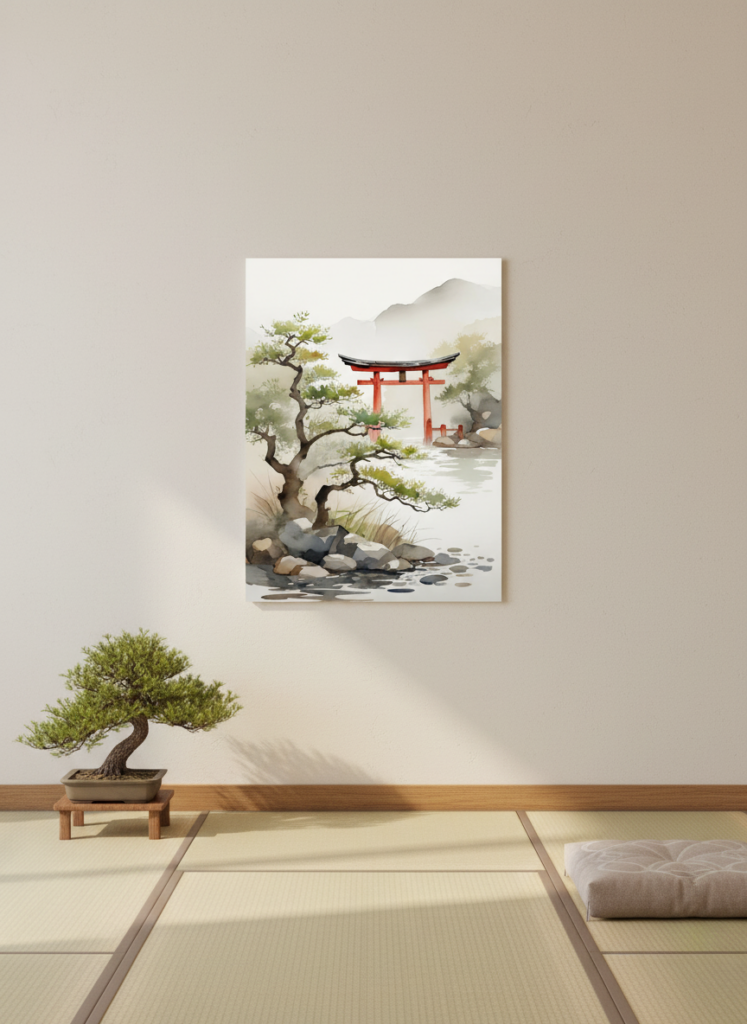
Soft, nature-inspired tones bring a calming quality to a workspace, helping reduce visual fatigue during long hours at the desk.
This is our own design on Displate — buying through our link earns us a small commission at no extra cost to you. Details
👉 View this design on Displate
Nature vs. Geometric: What Each Does for the Mind
Two broad categories of art tend to suit workspaces, and they do slightly different jobs.
Nature imagery — landscapes, forests, water, mountains — has a well-documented calming effect. Looking at natural scenes, even in a picture, gives the mind a brief mental reset, which is why a nature piece is so effective in a high-stress role. If your work is demanding or screen-heavy, nature art is a reliable choice for a restorative backdrop.
Geometric and abstract art does something different. Clean lines and structured patterns can feel orderly and stimulating without being literal, which suits creative or analytical work where you want energy and a sense of structure. The key with geometric art in an office is to keep it on the calmer end — ordered rather than chaotic — so it adds rhythm without adding noise.
A practical approach: if your job already feels chaotic, lean toward calming nature art to balance it. If your work feels monotonous and you need a lift, a structured geometric piece can add welcome energy.
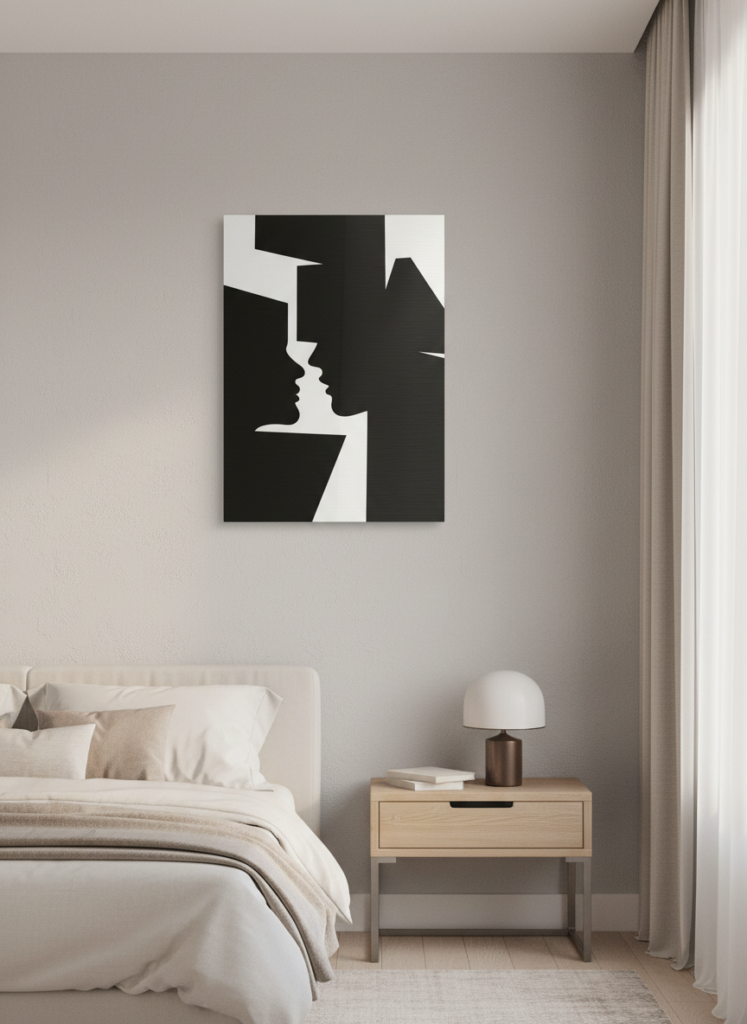
Clean, structured abstract designs add a sense of order and quiet energy — a strong fit for a focused workspace.
This is our own design on Displate — buying through our link earns us a small commission at no extra cost to you. Details
👉 View this design on Displate
A Place for Motivation — Used Wisely
Motivational art has a place in the office, but it’s worth being thoughtful about it. A piece with a powerful image or a short, meaningful phrase can genuinely set the tone for your day. The trick is restraint: one strong motivational piece works far better than a wall plastered with quotes, which quickly fades into background noise you stop seeing.
If you go this route, choose something that resonates with you specifically rather than a generic slogan. A bold, striking image you connect with — something that represents drive, resilience, or ambition — will keep its impact far longer than a tired phrase.
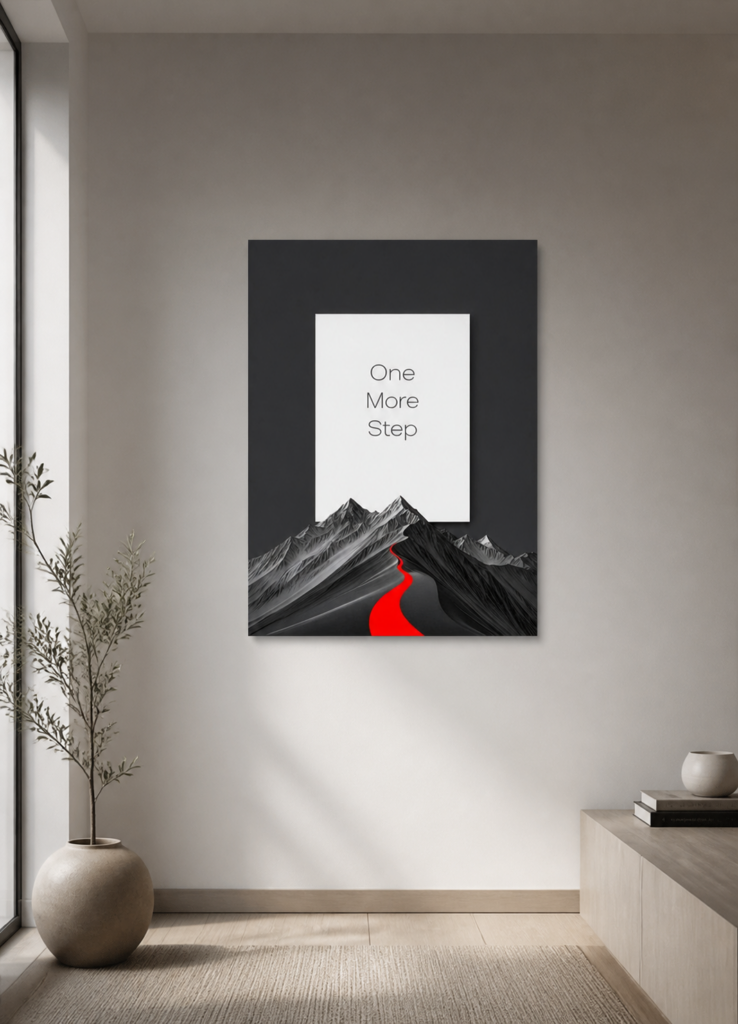
A single strong motivational piece sets the tone for the day — far more effective than a wall crowded with slogans.
This is our own design on Displate — buying through our link earns us a small commission at no extra cost to you. Details
👉 View this design on Displate
Practical Placement Tips
Beyond the art itself, where and how you hang it matters in an office more than almost any other room.
Mind the glare. Glossy surfaces can reflect light from windows and desk lamps, creating distracting hotspots. If your office is bright or you use a strong task light, a matte finish will read more clearly from your working position.
Hang it at seated eye level, not standing eye level. You’ll spend most of your time in the room sitting down, so position art relative to where your eyes actually are when you’re working.
Keep the wall directly behind your monitor calmer, and save bolder pieces for the walls in your peripheral vision. This gives you energy in the room without competition in your direct line of sight.
And don’t overcrowd. In a focus-driven space, one well-chosen piece per wall almost always beats a busy cluster.
Bringing It All Together
A home office that helps you focus isn’t about filling the walls — it’s about choosing deliberately. Use cool tones to calm a high-stress role or warm accents to lift a cold one, lean on nature art for restoration and geometric art for structured energy, and let a single motivational piece carry the room rather than a crowd of slogans. Pay attention to glare, eye level, and what sits directly in your line of sight.
Get those choices right and your office stops being just a place you work — it becomes a space that quietly works for you.
Not sure how large your office piece should be? Our guide on how to choose the right wall art size for any room covers proportions. And to match your art’s tones to your workspace, how to choose wall art colors that match your room pairs well with this one.
Published 06/15/2026 · Last updated 06/16/2026