A blank wall is full of possibilities — but the moment you try to fill it, one question stops most people in their tracks: what size should the art actually be? Go too small and the piece looks lost, like a postage stamp on a billboard. Go too big and it overwhelms everything around it. Getting the size right is the difference between art that feels intentional and art that feels like an afterthought.
The good news is that there are a few simple rules interior designers use, and once you know them, sizing wall art becomes easy. This guide walks you through them room by room.
The Golden Rule: Fill 60–75% of the Wall Space
If you remember nothing else from this guide, remember this: your art should fill roughly two-thirds of the available wall or furniture width. This is the single most useful rule in the entire process.
For a wall on its own, measure the width and aim to cover 60–75% of it. For art going above furniture — a sofa, bed, or console — measure the furniture, not the whole wall, and fill about two-thirds of that width. So if your console is around 100 cm (39 in) wide, a piece about 65–75 cm wide fills it beautifully. This simple check instantly rules out the “tiny frame floating in space” mistake that makes so many rooms feel unfinished.
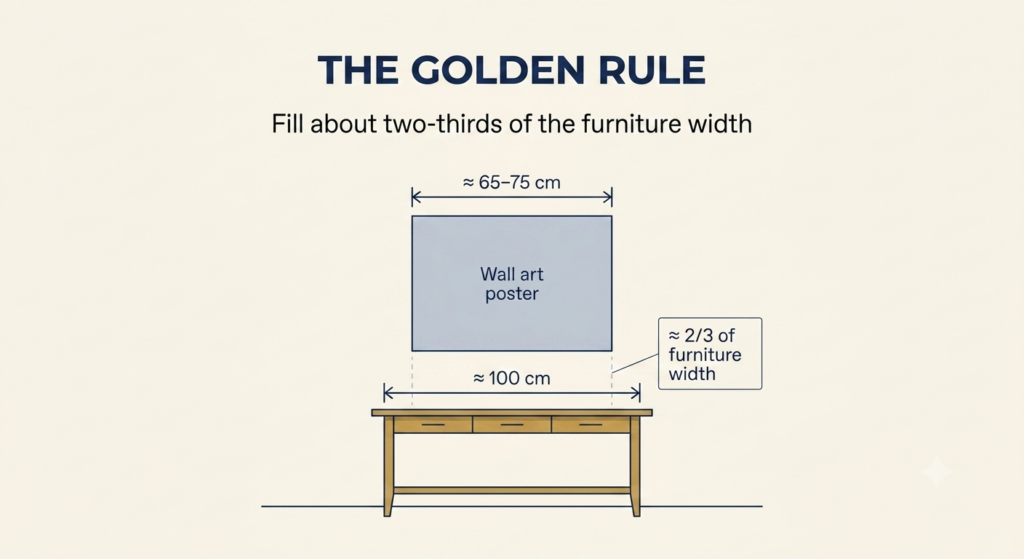
The two-thirds rule in practice — a piece about 65–75 cm wide fills a 100 cm console beautifully.
Living Room: Make a Statement
The living room is usually where you want your boldest piece, because it’s the room people gather in and the one guests see first.
Above a sofa: This is prime territory for a large piece. A single dramatic design becomes the centerpiece of the whole room, though two medium prints side by side also work for a gallery feel.
On a large empty wall: Go big. An oversized piece turns a plain wall into a focal point, and a single bold design often looks more sophisticated than several small ones scattered around.
Hanging height: Center the artwork at eye level — about 145–152 cm (57–60 in) from the floor to the middle of the piece. Above a sofa, leave roughly 20–25 cm (8–10 in) between the top of the couch and the bottom of the art.
Bedroom: Calm and Balanced
Bedrooms call for art that feels restful rather than loud, and the bed is almost always the anchor point.
Above the headboard: Match the art to roughly two-thirds of the bed’s width. Above a typical double or queen bed, a single large piece makes a calming centerpiece — or two smaller prints side by side for a symmetrical look.
Vertical wall space: If you have a tall, narrow wall — beside a window or in a reading nook — a portrait-orientation piece uses the height gracefully without dominating the room.
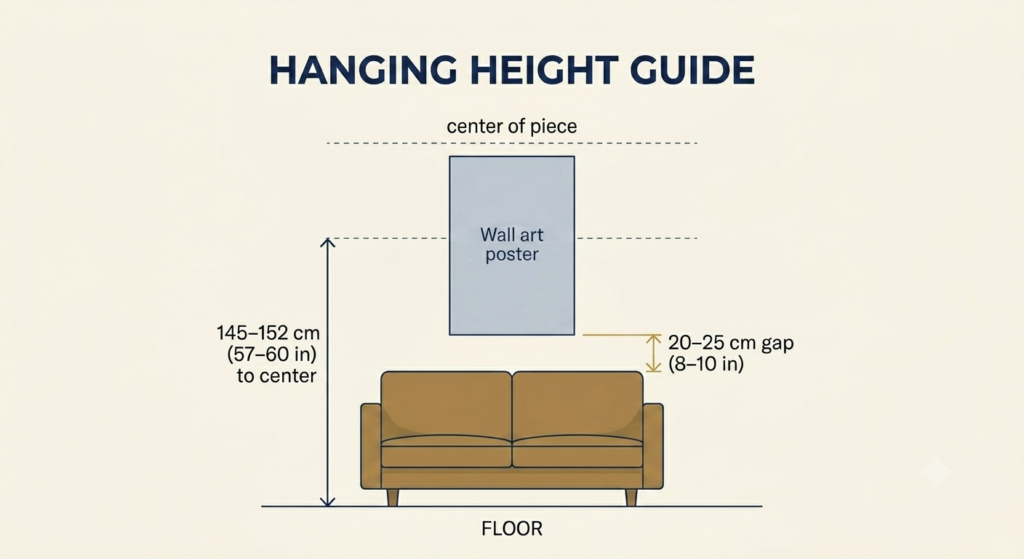
Hanging height at a glance: center the piece 145–152 cm from the floor, with a 20–25 cm gap above the sofa.
Home Office: Motivate and Focus
Your office art should do a job: keep you inspired without distracting you. This is where motivational and typography pieces shine.
Above the desk: A single medium piece sits at eye level and gives you something energizing to look up at, without crowding your workspace.
Behind you (for video calls): A bold, clean design makes a great backdrop. Pick something that reflects your personality but isn’t so busy it pulls focus on camera.
Hallways and Narrow Spaces: Think in Sets
Long, narrow walls are perfect for a series of smaller prints rather than one large piece. Three or four evenly spaced posters lead the eye down the hall and turn a forgotten corridor into a mini gallery. Keep consistent spacing — about 5–10 cm (2–4 in) between pieces — so the grouping reads as one intentional display.
Don’t Forget Orientation
Size isn’t only about how big — it’s about shape, too. Portrait (vertical) pieces emphasize height and suit narrow walls or spaces above furniture. Landscape (horizontal) pieces work above wide furniture like sofas and beds. Whichever you choose, the same two-thirds rule applies.
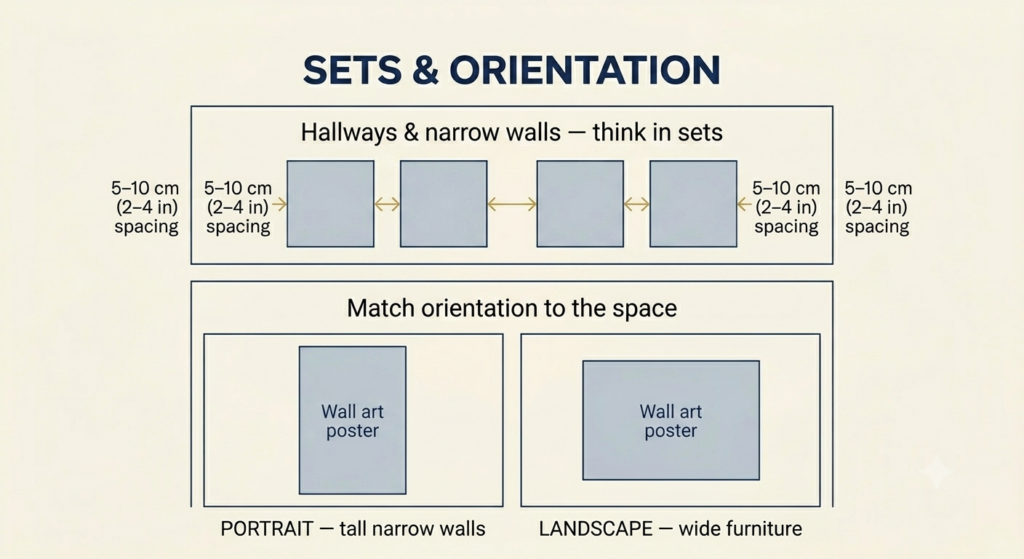
Group smaller prints with even 5–10 cm spacing, and match orientation — portrait for narrow walls, landscape for wide furniture.
One Easy Trick Before You Buy
Still unsure between two sizes? Cut a piece of paper or cardboard to the size you’re considering and tape it to the wall. Live with it for a day. Seeing the actual footprint in your space removes all the guesswork — and it’s saved countless people from ordering something too small.
Final Thoughts
Choosing the right size really comes down to one habit: measure first, then match the art to about two-thirds of your space. Mind your hanging height, consider orientation, and your walls will look like they were styled by a pro.
Published 06/14/2026 · Last updated 06/16/2026